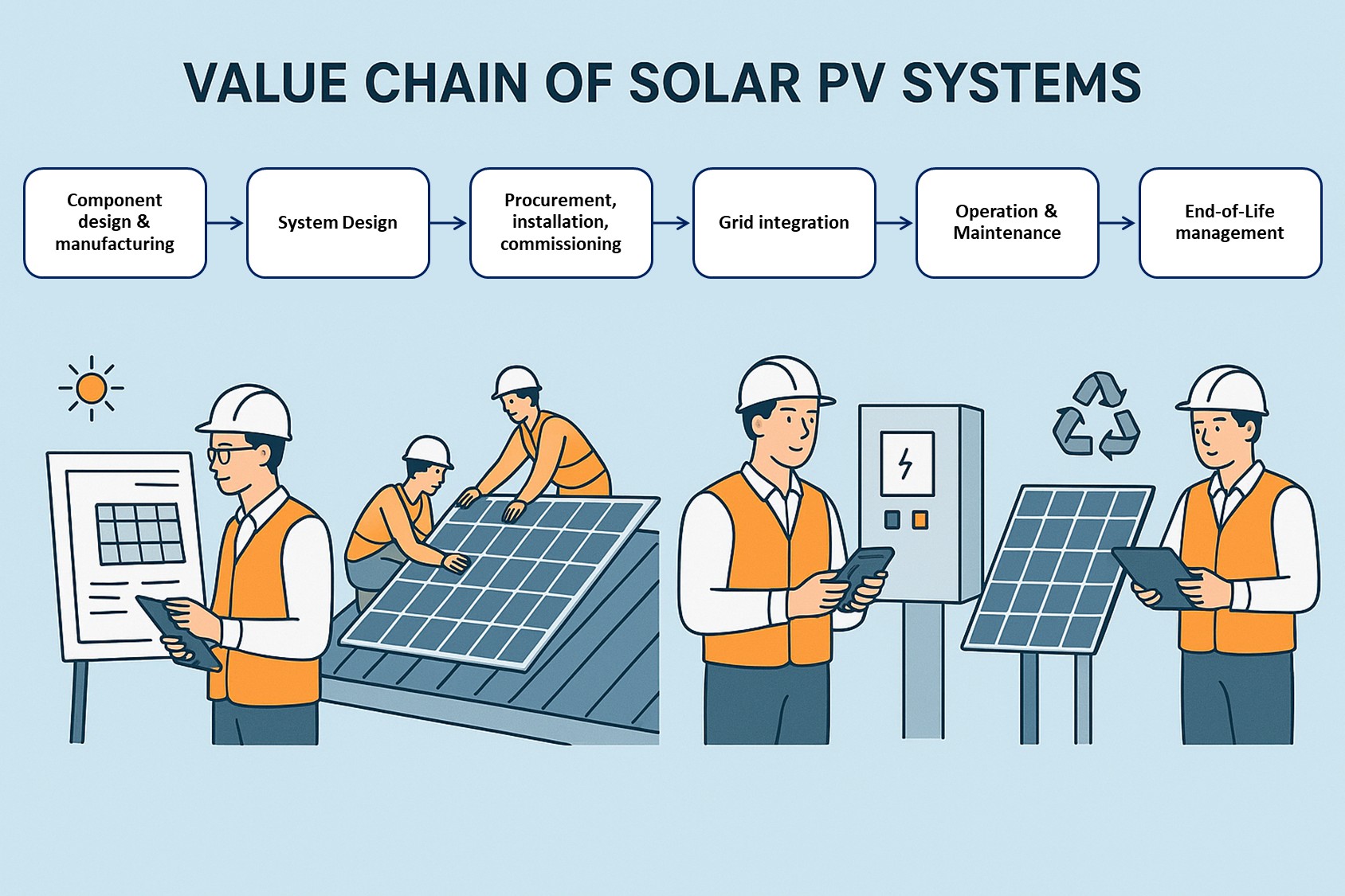
The value chain of a solar photovoltaic (PV) system (see figure below) comprises seven main stages, beginning with component design and manufacturing and concluding with end-of-life (EOL) management, including the reuse and recycling of components and materials.
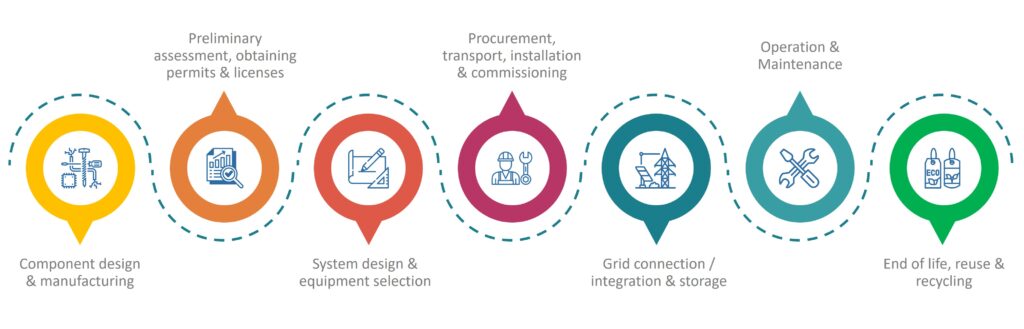
Each stage of the solar PV value chain presents distinct risks and opportunities that can affect the performance and viability of investments. This article explores these factors in the context of Armenia’s renewable energy market and highlights the corresponding elements of the Quality Infrastructure (meaning standardization, technical regulation, accreditation, conformity assessment, market surveillance and metrology) designed to address and mitigate them.
A. Component design and manufacturing
While the components of solar photovoltaic (PV) systems may appear simple, their design and manufacturing involve a complex series of assembly, measurement, testing, and validation processes to ensure reliable performance under diverse climatic conditions and both static and dynamic loads. Failure to meet quality and technical safety requirements can result in serious occupational health and safety hazards, including fires, electrocution, and detached PV modules or mounting structures being dislodged by wind gusts.
International technical standards, such as those developed by the International Electrotechnical Commission (IEC) and Underwriters Laboratories (UL), define requirements for design and safety qualification, test methods, type approval, and energy rating for all components of a solar PV system.
With recent global and national efforts to promote solar photovoltaics, PV module assembly is emerging as a promising sector for local economic development and job creation in Armenia. However, the industry faces several challenges, including a significant decline in global PV module prices over the past decade, a small share of the local market, and the absence of mechanisms to encourage the use of domestically produced modules.
Currently, three local companies claim to manufacture solar PV modules in Armenia, although only two are actively operating. These producers import solar cells and other PV module components, conduct cell-level testing—such as electroluminescence (EL) testing—and assemble modules in their own facilities. Local manufacturers supply PV modules to both domestic and international markets, either exporting their products or using them in projects implemented abroad, including in the United States and EU countries. Key details include:
-
The combined annual production capacity is approximately 410 MW—about 60 MW from Company A and 350 MW from Company B.
-
Both companies possess in-house equipment and processes for testing raw materials and finished products, including EL imaging, flash testing, thermal imaging, and mechanical testing (the latter performed by one of the two companies).
-
Both companies are certified against international ISO 9001, ISO 14001, and ISO 45001 standards.
-
PV modules produced by these companies are certified by recognized bodies such as TÜV Rheinland, DEKRA Certification B.V., and INTERTEK, meeting international standards including IEC 61215 (Design Qualification and Type Approval), IEC 61730 (PV Module Safety Qualification), and IEC TS 62804-1-1 (Potential Induced Degradation, PID).
To remain competitive and grow, Armenian PV module producers must not only build trust with local and international project developers through high-quality and safe products but also compete with well-established global manufacturers. These international competitors leverage brand recognition and greater pricing flexibility due to economies of scale.
Financial pressures can sometimes lead to trade-offs in quality, which may reduce the efficiency and lifespan of the final product. The risk of substandard PV modules and other components is particularly high when cost reduction is prioritized, especially in contexts where quality standards are not stringent and quality control is insufficient.
QI services: Solar PV components are required to be certified (conformity assessment) by accredited certification bodies against the requirements of international technical standards, whereas, the manufacturers are also obliged to be certified against certain management standards such as ISO 9001 and ISO 14001.
B. Preliminary assessment, obtaining permits and licenses
The preliminary assessment is the first and arguably one of the most critical steps in the lifecycle of a solar photovoltaic (PV) project. It involves evaluating the technical, environmental, financial, and regulatory feasibility of the proposed project. During this phase, key factors such as solar irradiance, land suitability, grid connectivity, and anticipated energy yield are analyzed. A thorough preliminary assessment helps identify potential risks, optimize project design, and ensure that the project is viable before significant investments are made. Skipping or underestimating this stage can lead to unforeseen challenges later in the project lifecycle, including delays, cost overruns, and regulatory non-compliance.
Several critical considerations are often overlooked by project developers, financial institutions, and market regulators or operators responsible for issuing permits and licenses:
-
Thorough Solar Resource Assessment (SRA): It is essential to evaluate the long-term variability of the solar resource at the project site. Using solar irradiance data with only 50-percent precision, especially for commercial and utility-scale projects, can lead to inaccurate energy yield projections and suboptimal investment decisions.
-
Detailed Energy Yield Assessment (EYA): A comprehensive EYA should account for uncertainties in both the solar resource and system design, including the performance degradation of the PV system over its lifetime. High-precision energy yield estimates, such as P90 rather than P50 probability of occurrence, enable developers and financiers to plan investments with greater confidence and reduce financial risk.
-
Grid Integration Assessment: Medium- to long-term forecasting and impact assessment are critical when integrating the solar PV system with the electricity grid. This analysis must consider the intermittency and variability of solar generation, as well as the potential effects on the quality, stability, and reliability of electricity supply. Proper evaluation ensures that PV integration does not compromise grid performance or lead to costly operational challenges.
QI services: National regulatory framework should define requirements for preliminary assessment, permitting and licensing processes. Metrology services play a crucial role in calibration of equipment and systems utilized in monitoring and recording solar resource and weather data – which play a pivotal role in energy yield assessment and project planning.
C. System design and equipment selection
System design and equipment selection are of paramount importance for several reasons:
i. Efficiency, performance and optimal energy production: The design of a solar PV system, including the selection of components like solar panels, inverters, cables and mounting structures, significantly impacts the system’s overall efficiency and performance. A well-designed system optimized for the local climate and solar conditions will maximize energy production. The design and component selection should take into account factors like shading, orientation, and tilt angles to maximize energy production. This optimization can lead to increased energy generation and financial savings.
ii. Reliability and Longevity: Proper equipment selection is crucial for the long-term reliability and longevity of a solar PV system. High-quality components that are well-suited to the specific application reduce the risk of component failures and ensure the system operates effectively for many years.
iii. Safety: Ensuring the safety of a solar PV system is a top priority. Proper design includes considerations for electrical safety, structural integrity, and fire prevention. Equipment selection plays a vital role in meeting safety standards and regulations.
iv. Cost Efficiency: A well-designed system with carefully selected equipment balances the initial installation cost along with the operational expenses. Cost-efficient choices will lead to a quicker return on investment for the system owner.
v. Environmental Impact: When planning a large-scale solar PV plant, the environmental and social impact of the project should be thoroughly assessed and managed. Any impact on natural monuments, endangered species and cultural heritage along with unnecessary resettlement of indigenous people should be avoided.
vi. Compliance and Regulations: Meeting local, regional, and national regulations and standards is essential. Proper system design and equipment selection ensure compliance with safety and electrical codes, as well as any incentives or rebates offered for renewable energy installations.
vii. Aesthetics and Integration: Design considerations include the aesthetics of the installation and how well it integrates with the surrounding environment. This is especially important for residential and commercial installations where visual appeal matters.
viii. Scalability and Future Expansion: The initial system design should also account for potential future expansion or upgrades. Properly designed systems can be more easily expanded to meet increased energy demands.
Several international standards such as but not limited to IEC TS 62738, IEC 62548:2016, IEC 62124, IEC 62109-1:2010, IEC 61727:2004, IEC 60364-7-712:2019 and EN 62093:2005 define technical requirements for design, safety and verification of solar PV systems. Moreover, in the absence of solar PV-specific national requirements, it is recommended to follow the international technical guidelines, safety and design codes such as the United States National Fire Protection Association’s NFPA 70 or the National Electrical Code (NEC).
QI services: National regulatory framework should define requirements for system design and equipment selection. Market surveillance monitors and oversees the compliance of products traded and utilized in the market.
D. Procurement, transport, installation and commissioning
Transport, installation and commissioning phases are where most quality and safety issues tend to occur. Solar PV components are transported by international shipping companies and/or freight forwarders with proper specialization. Solar modules are packaged using protective materials such as crates, pallets, or containers to ensure safe transport. They are often secured with foam or bubble wrap to prevent damage from impacts during transit.
Installing PV systems requires specific expertise, which is sometimes lacking especially when new brigades are not properly instructed prior to being assigned to an installation project. As a result, PV modules might be damaged during domestic transportation or installation, insufficient attention is given to electrical safety requirements, and minor or major workmanship issues, such as loose screws, improperly connected connectors, or unstable mounting structures, can hinder the system’s correct operation, posing risks to operators and local residents. Some of these defects may be immediately noticeable, while others may require a thorough system check to confirm its safe operation and adherence to quality standards.
To enhance and ensure quality and safety of solar PV systems it is recommended to:
-
Develop and adopt PV-specific installation and commissioning standards that define clear technical, safety, and performance criteria.
-
Develop and conduct training and licensing programs for inspectors and installation personnel.
-
Establish mandatory inspection framework and protocols tailored to PV systems, which will cover not only commercial and utility-scale PV plants but also the small-scale autonomous systems.
QI services: Technical standards and requirements should be integrated into regulatory framework, public procurement, government initiatives, and contractual obligations. At the same time, raising awareness and providing education are vital to encourage voluntary adoption and to strengthen the perception of standards as drivers of quality, safety, and competitiveness.
E. Grid connection, integration and storage
Grid connection and integration are critical steps in the lifecycle of solar PV systems, as they determine how effectively the generated electricity can be delivered to end-users while maintaining the stability and reliability of the power system. Proper integration ensures optimal utilization of renewable energy, supports grid balancing, and enables accurate forecasting of electricity generation.
However, integrating solar PV into the grid presents several challenges. The variable and intermittent nature of solar power can cause voltage fluctuations, frequency deviations, and reverse power flows, which may impact grid stability. In addition, inadequate grid infrastructure, limited flexibility of existing network assets, and a lack of standardized technical procedures for PV integration can hinder efficient operation.
Addressing these challenges requires comprehensive planning, advanced forecasting tools, technical standards for interconnection, and investment in grid modernization to ensure that solar PV contributes reliably and safely to the overall electricity system.
Producers and distributors each define and monitor key performance indicators (KPIs) to assess the performance of their assets and ensure the quality and reliability of their products and services. To mitigate the impact of the distribution or transmission network on a PV plant’s performance and to set realistic investment targets, plant owners and operators should constantly monitor grid-related indicators which affect their PV plant. Monitoring these parameters helps identify potential constraints or disturbances caused by the grid, enabling operators to optimize plant performance, protect equipment, and ensure the long-term reliability and efficiency of the PV system.
On the grid side, the distribution system operator (DSO) monitors indicators such as the System Average Interruption Duration Index (SAIDI) and System Average Interruption Frequency Index (SAIFI), voltage and frequency fluctuations, power factor distortions. International standards such as IEEE 1366 – 2012 “IEEE Guide for Electric Power Distribution Reliability Indices”, provide a detailed set of cause codes for interruptions, which enables the DSO to identify the true cause of the interruption. Failing to comply with requirements of such standards constrains the ability of the DSO, the market operator and regulator to perform a detailed root-cause analysis, resulting in absence of a precise assessment of the impact of the increasing number and capacity of autonomous solar PV systems on the distribution network’s quality indicators.
QI services: National regulatory framework should define requirements for grid integration of solar PV systems, along with integration of these systems with storage facilities. Compliance should be actively monitored under market surveillance.
F. Operation and Maintenance (O&M)
Regular maintenance and continuous monitoring are essential during the operation phase to identify defects that could compromise the performance and safety of a PV system. Preventive maintenance should be planned and implemented according to the scale of the PV plant and local environmental conditions. The maintenance plan should specify the types of activities, their frequency, and the parameters to be monitored. Key parameters include DC current and voltage at the string level (and annually at the module level), AC current and voltage, power output, performance ratio, PV module temperature, ambient temperature, solar irradiance, grid voltage and frequency, as well as alarms and detected faults. Systematic monitoring and timely maintenance help optimize energy yield, extend equipment lifespan, and ensure safe and reliable operation of the PV system.
QI services: Technical standards such as IEC 62446-1:2016+AMD1:2018, IEC 61724-2:2017, IEC 61724-3:2018 and IEC 61724 define requirements for solar PV system testing, performance monitoring, documentation and maintenance.
G. End of life, reuse and recycling
End-of-life (EOL) management of solar PV components is a critical aspect of the PV system lifecycle, ensuring environmental sustainability and resource efficiency. As PV modules, inverters, batteries, and other system components reach the end of their operational life, proper disposal, reuse, or recycling becomes essential to prevent environmental pollution and recover valuable materials such as silicon, glass, and metals. Effective EOL strategies include establishing collection and recycling programs, designing modules for easier disassembly, and implementing policies that hold manufacturers and operators accountable for responsible waste management. Additionally, integrating EOL considerations during the design and procurement stages can extend component life, reduce waste, and support circular economy principles, ultimately contributing to the long-term sustainability of the solar PV industry.
Resources:
Quality infrastructure for PV (QI4PV) in Armenia: Presentation of gaps and proposed roadmap
Comments are closed